.png)

The Golden Thread: Understanding the Western Mystery Tradition and the Golden Dawn

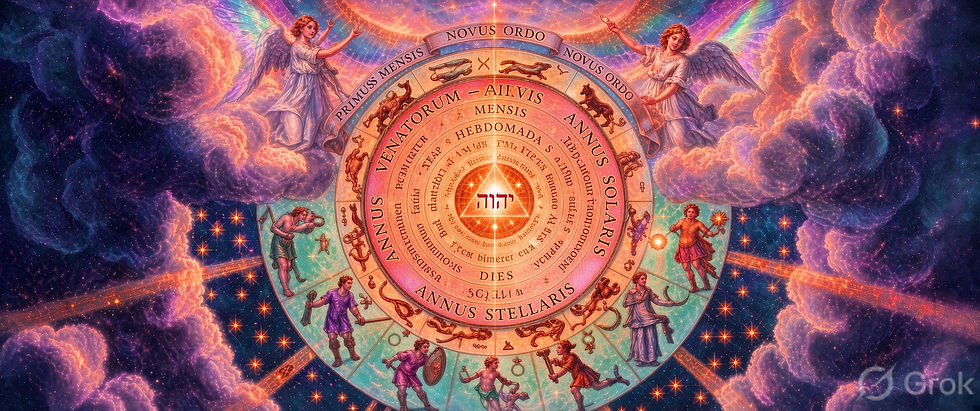
Synthesis and Origin: The Essence of the Tradition
The Western Mystery Tradition (WMT) is a rich, syncretistic tapestry woven from the diverse spiritual and philosophical currents of the West. It is not a single religion but a framework that unifies various branches of esoteric knowledge, most notably Renaissance Kabbalah, Hermeticism, Alchemy and the Rosicrucian mythos, into a cohesive path of personal and spiritual transmutation.
Its roots are ancient, stretching back to the wisdom of Ancient Egypt and the Neoplatonists of Alexandria, such as Iamblichus. However, the tradition saw a profound revival during the Renaissance, where scholars like Marsilio Ficino and Giovanni di Pico della Mirandola integrated the Jewish Kabbalah into a Christian and Hermetic framework. This "Hermetic framework" became the crucible in which the modern seeker attempts not merely to worship the divine, but to experience a "supernatural communion" with it and, ultimately, to undergo a process of spiritual alchemy.
The 18th Century Precursors: The Rosicrucian Bridge to Western Mystery Tradition and the Golden Dawn
While many associate the structured "Orders" of this tradition with the Victorian era, the essential architecture was forged in the 18th century. During this period, the "Orden des Gold und Rosenkreuzer" (Order of the Golden and Rosy Cross) was founded in Germany (circa 1750s). This 18th-century movement provided the grade structure and much of the alchemical symbolism that would later define the Golden Dawn.
In 18th-century England, the tradition flourished primarily through the growth of Freemasonic networks, liked to European networks, which served as a "positive influence on society" and a repository for esoteric research. It was through these masonic lineages, specifically the Societas Rosicruciana in Anglia (SRIA), founded in 1865 but deeply rooted in earlier masonic Rosicrucianism, that the founders of the Golden Dawn would eventually emerge.
The Hermetic Order of the Golden Dawn: 1888 and the Great Synthesis
The Hermetic Order of the Golden Dawn, founded in 1888 by Dr. William Wynn Westcott, Dr. William Robert Woodman, and Samuel Liddell MacGregor Mathers, represents the pinnacle of the WMT’s codification. Although established in the late 19th century, Westcott claimed a legitimate "Apostolic succession" from the 18th-century German Rosicrucians, specifically through a mysterious adept named Anna Sprengel.
The Order’s brilliance lay in its ability to take fluid, often contradictory esoteric traditions and standardize them into a rigorous curriculum. For the first time, elements such as the Hebrew alphabet, Egyptian deities, alchemical processes, and the Tarot were systematically "attributed" to the Qabalistic Tree of Life.
Key Components of the Golden Dawn System
Tradition | Application in the Order |
Qabalah | Used as the primary framework or "filing system" for all other correspondences. |
Alchemy | Viewed as both a physical laboratory practice and a spiritual "inner alchemy" of the soul. |
Hermeticism | The study of the "Magic of Hermes" and the principles of Occult Science. |
Ritual Magic | Codified rites like the Lesser Banishing Ritual of the Pentagram (LBRP) for protection and meditation. |
A Legacy of Transcendence
The Golden Dawn was revolutionary in its time, notably admitting men and women on an equal basis; a departure from the purely masonic societies of the 18th century. It transformed the "visionary" aspects of mysticism into "practical" methods of study and ritual.
Members were taught that through the study of these "Ancient Mysteries," they could achieve the Summum Bonum: True Wisdom and Perfect Happiness. Even though the original Order fractured in 1903, the system it created remains the most influential foundation for Western esotericism today, proving that the "Golden Thread" of the western mystery tradition and the golden dawn continues to vibrate through the centuries.
Comments